My OSR System

Contents
- Introduction
- Classes
- Hit protection
- Ability scores
- Advantages & disadvantages, enhancements & impairments
- Combat
- Level advancement
- Equipment
- Fighter
- Dwarf
- Cleric
- Magic User
- Thief
- Elf
- Halfling
Introduction
This system combines ItO-like systems (Into the Odd, Knave, Cairn, etc.) with D&D B/X. It uses the B/X classes and their hit dice (d8 for fighter, d6 for cleric, etc.) but instead of hit points, it uses the ItO-like rules of hit protection (HP).
Ability scores are also ItO-like: STR, DEX, WIL, while saving throws happen as roll-under ability saves.
The game retains XP and level advancement, but levels are simulated through increase of HP & ability scores, along with a classic "roll 2 dice and keep the best (or worst) result" advantage/disadvantage mechanic.
Combat follows the ItO approach entirely, without hit points or attack rolls. Enhanced and impaired attacks are resolved as in Into the Odd.
Deprivation and fatigue mechanics follow Cairn's system.
For magic, use the B/X spell lists and improvise as needed. For monsters, cross-reference B/X sources with ItO-like bestiaries and convert loosely; the system is meant to be flexible in this regard.
Classes
The B/X classes are used, with their respective hit dice:
See each individual class for details.
Hit protection
This system copies Into the Odd for combat & damage. There are neither hit points nor attack / to-hit rolls. Instead, HP (hit protection) is used to express the amount of hits a creature can avoid before getting tired and starting receiving damage.
However, the B/X classes hit dice are used here: each class starts with HP points equal to the result of a roll of its hit dice (e.g. d4 for a thief).
Ability scores
Abilities are STR, DEX, WIL and their scores are rolled upon character creation using 3d6.
Ability saves are d20, with success being a roll of equal or lower.
Advantages & disadvantages, enhancements & impairments
Instead of modifiers, this system uses two methods of affecting die rolls:
Advantages (ADV) & disadvantages (DSV)
This method is mostly used to create the sense of a gradual improvement of rolls and saving throws as a character advances in level.
Common examples:
- When a character that is not a fighter attempts to use an unfamiliar weapon, they do so with DSV.
- A 1st-level thief rolls all their thieving ability saves as DEX save DSV, but they gradually improve them. (See class of Thief.)
- A mid-level cleric turns weak undead with ADV and powerful ones with DSV. (See class of Cleric.)
This is how this method works:
- ADV: Roll 2 dice and keep the best result.
- DSV: Roll 2 dice and keep the worst result
For damage rolls, ADV means you keep the higher result of the two dice; for ability saves, the lower. The reverse applies to DSV.
E.g. WIL save ADV means roll a WIL save with advantage.
Enhancements & impairments
This is only used as a method of affecting attacks in combat. Instead of rolling the normal damage die of the creature's weapon (ranging from 1d6 to 1d10, if armed), an affected attack calls for the following rolls:
- Enhanced attack: Roll 1d12 for damage
- Impaired attack: Roll 1d4 for damage
Notes on detatchments
A detachment's attacks are by default enhanced. Individual creatures' attacks vs. a detachment are by default impaired.
💡 When dealing with detachments, individuals or small groups must negate the detachment's superiority through clever strategy, thus negating the enhanced/impaired dynamic. The referee will be the judge of the strategy's effectiveness.
Combat
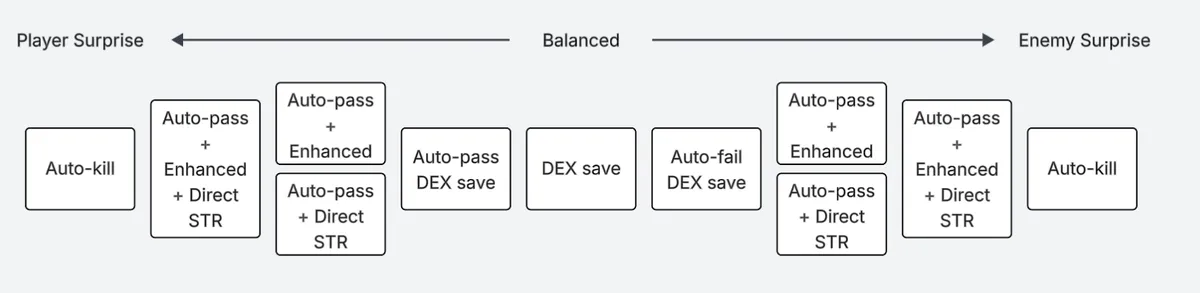
Surprise / Initiative: Players roll a successful DEX save to avoid surprise disadvantages or simply play an extra round before the monsters.
As surprise disadvantages vs simply losing initiative, see some optional examples in the following table (temporary in image form):
Multiple attacks: When multiple attacks target the same creature, the resulting damage equals their highest result (and not their sum).
Level advancement
When characters gain a level, they increase their HP or STR, according to their class's hit die and advancement cycle.
Each time a character advances a level:
- HP: The character rolls their class's hit die (e.g. d8 for dwarf) and add the result to their HP. This is their new HP.
- Ability scores: They roll ability saves, incrementing the respective ability score by 1 if the save is successful.
- Class's special abilities: These are also improved, as described per class. For example, fighters gain weapon mastery, while magic-users learn to cast more spells. Full details of these progressions are given in the class descriptions.
⚠️ No score can exceed 18. When an ability score reaches 18, no more rolls are made with each new level.
Equipment
See each class for possible restrictions concerning weapons and armour.
Classes other than fighters and dwarves roll with disadvantage when using an unfamiliar weapon; this penalty is removed when they gain a level, provided they've been using that weapon regularly.
Encumbrance: 10 slots by default + 1 slot added every 2 points of STR above 10.
E.g. a 13-STR character will have 11 slots.
Fighter
Expand class information
HP & STR advancement
During character creation, a fighter rolls 1d8 for HP. For STR, DEX, and WIL, they roll 3d6, like all other classes.
Every time they advance a level, a fighter:
- Increases their HP by 1d8.
- Saves for each ability score under 18, incrementing the score by 1 if the save is successful.
Weapons
Fighters can use any weapon. Moreover, because they have trained with a wide variety of weapons, they find it relatively easy to adapt to any new one they pick up. (Other classes roll with disadvantage when using an unfamiliar weapon until they gain a level.)
Additionally, fighters can improve their weapon skills. A fighter who regularly uses a specific type of weapon while advancing through 3 experience levels gains weapon mastery with that weapon and rolls damage for that weapon with advantage.
⚠️ If a fighter uses two kinds of weapons in roughly equal amounts, they may choose which one they master first. The other can be mastered at the next level of advancement.
Armour
Fighters can wear any armour.
Dwarf
Expand class information
HP & STR advancement
During character creation, a dwarf (like the fighter) rolls 1d8 for HP. For STR, DEX, and WIL, they roll 3d6, like all other classes.
Every time they advance a level, a dwarf:
- Increases their HP by 1d8.
- Saves for each ability score under 18, incrementing the score by 1 if the save is successful.
Weapons
Dwarves can use any weapon except long bows and two-handed swords. Like fighters, dwarves have trained with a wide variety of weapons and thus find it relatively easy to adapt to any new one they pick up.
(Other classes roll with disadvantage when using an unfamiliar weapon until they gain a level.)
Like fighters, dwarves can improve their weapon skills. A dwarf who regularly uses a specific type of weapon while advancing through 3 experience levels gains weapon mastery with that weapon and rolls damage for that weapon with advantage.
⚠️ If a dwarf uses two kinds of weapons in roughly equal amounts, they may choose which one they master first. The other can be mastered at the next level of advancement.
Armour
Dwarves can wear any type of armour.
Special abilities
Dwarves have the following special abilities:
- 60-foot infravision (optional)
- 1:3 probability of passively detecting secret doors, traps, and slanted floors
- ADV on WIL saves vs. spells and STR saves vs. poison
Cleric
Expand class information
HP & STR advancement
During character creation, a cleric rolls 1d6 for HP. For STR, DEX, and WIL, they roll 3d6, like all other classes.
Every time they advance a level, a cleric:
- Increases their HP by 1d6.
- Saves for each ability score under 18, incrementing the score by 1 if the save is successful.
- Gains spells.
- Increase their ability to turn undead.
Weapons
Clerics are not permitted to use slashing or piercing weapons. They may only wield bludgeoning weapons, such as maces or slings.
If a cleric uses an unfamiliar weapon, they roll with disadvantage. This penalty is removed once they gain a level, provided they've been using that weapon regularly.
Armour
Clerics can wear any armour.
Special abilities
Clerics have the following special abilities:
- Spellcasting: Starting from level 2, clerics can cast spells. Use B/X cleric spells as reference and improvise as needed.
- Turning undead: For turning undead, use the B/X tables but substitute the results as follows:
| D&D | Use instead |
|---|---|
| 7 | Cleric WIL save ADV |
| 9 | Cleric WIL save |
| 11 | Cleric WIL save DSV |
Magic User
Expand class information
HP & STR advancement
During character creation, a magic user rolls 1d4 for HP. For STR, DEX, and WIL, they roll 3d6, like all other classes.
Every time they advance a level, a magic user:
- Increases their HP by 1d4.
- Saves for each ability score under 18, incrementing the score by 1 if the save is successful.
- Gains spells.
Weapons
Magic users can only wield daggers and knives.
Armour
Magic users cannot wear armour or use shields.
Special abilities
Spellcasting; for magic user spells, see B/X and improvise.
Thief
Expand class information
HP & STR advancement
During character creation, a thief rolls 1d4 for HP. For STR, DEX, and WIL, they roll 3d6, like all other classes.
Every time they advance a level, a thief:
- Increases their HP by 1d4.
- Saves for each ability score under 18, incrementing the score by 1 if the save is successful.
Weapons
Thieves can use any type of weapon.
Armour
Thieves can only wear leather armour and cannot use a shield.
Special abilities
Thieves specialise in skills of stealth, trickery, and precision.
They roll for surprise / initiative (Cairn DEX save) with an ADV.
They are the only class able to:
- Pick locks
- Remove traps
- Discover advanced traps
- Climb steep surfaces
- Move silently
- Hide in shadows
- Pick pockets
- Detect noise
Anyone may attempt to find a trap by searching, but only thieves can disarm them delicately, without anyone getting hurt. They are also the only ones able to discover more advanced traps.
To attempt one of the abilities above, a thief makes a DEX save.
At 1st level, thieves perform all of these actions with disadvantage. Each time they gain a level, they gain 2 improvement steps to distribute among their abilities.
- One step removes DSV, raising the roll to normal.
- A second step upgrades it further to ADV.
For example, a 2nd level thief may have the following abilities:
| Ability | Modifier |
|---|---|
| Pick locks | DSV |
| Remove traps | Normal |
| Climb steep surfaces | DSV |
| Move silently | Normal |
| Hide in shadows | DSV |
| Pick pockets | DSV |
| Detect noise | DSV |
Elf
Expand class information
HP & STR advancement
During character creation, an elf rolls 1d6 for HP. For STR, DEX, and WIL, they roll 3d6, like all other classes.
Every time they advance a level, an elf:
- Increases their HP by 1d6.
- Saves for each ability score under 18, incrementing the score by 1 if the save is successful.
Weapons
They can use any type of weapon.
Armour
They can wear any type of armour, even when casting spells. They can also use shields.
Special abilities
Elves have the following special abilities:
- 60-foot infravision (optional)
- Spellcasting (magic-user spells)
- 1:3 probability of passively detecting secret doors, traps, and slanted floors
- Cannot be paralyzed by ghouls.
Halfling
Expand class information
HP & STR advancement
During character creation, a halfling rolls 1d6 for HP. For STR, DEX, and WIL, they roll 3d6, like all other classes.
Every time they advance a level, a halfling:
- Increases their HP by 1d6.
- Saves for each ability score under 18, incrementing the score by 1 if the save is successful.
Weapons
Halflings can use any type of weapon which has been designed or "cut down" to their size. Thus, they cannot use a two-handed sword or a long bow, but may use a sword or short bow.
Armour
The same applies to armour: they can use any type designed for their size.
Special abilities
Halflings have the following special abilities:
- Naturally easy to hide in shadows like a thief (ADV on a DEX save)
- Large creatures' attacks vs. halflings are impaired
- ADV on DEX saves, including combat initiative
- ADV on WIL saves vs. spells and STR saves vs. poison
- ADV on damage when using missile weapons
⚠️ Halflings do not have infravision, according to the RAW of B/X. In any case,